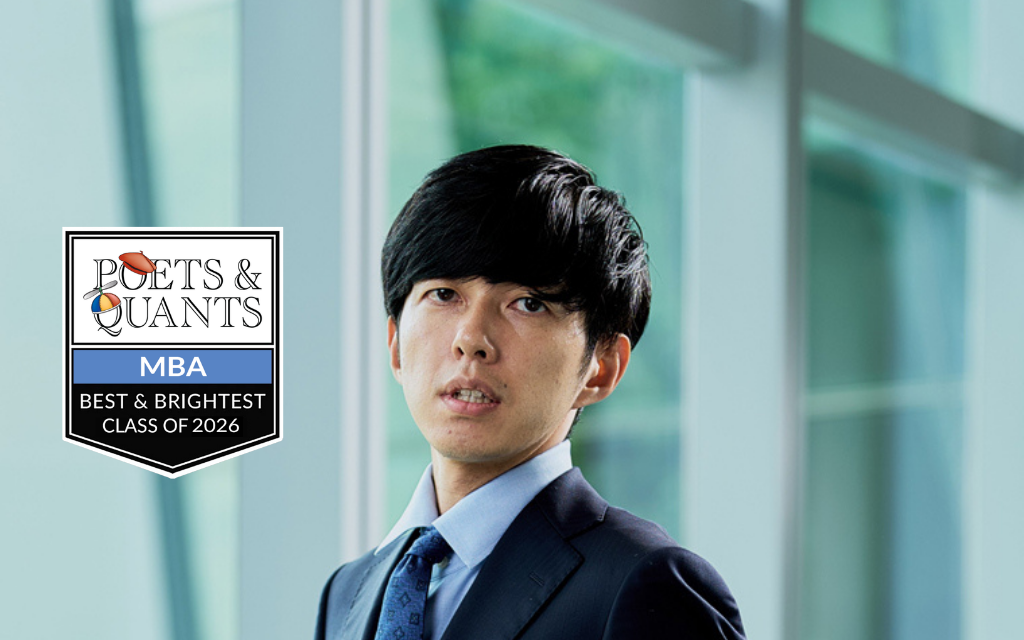
P&Q 2026 Best & Brightest MBAs: NUS MBA’s Wataru Komai
Heartiest congratulations to Wataru from the Class of 2026 who have made it to the Poets & Quants’ 2026 MBAs To Watch list!
Learn more about him in the article below, and check out the full list here.
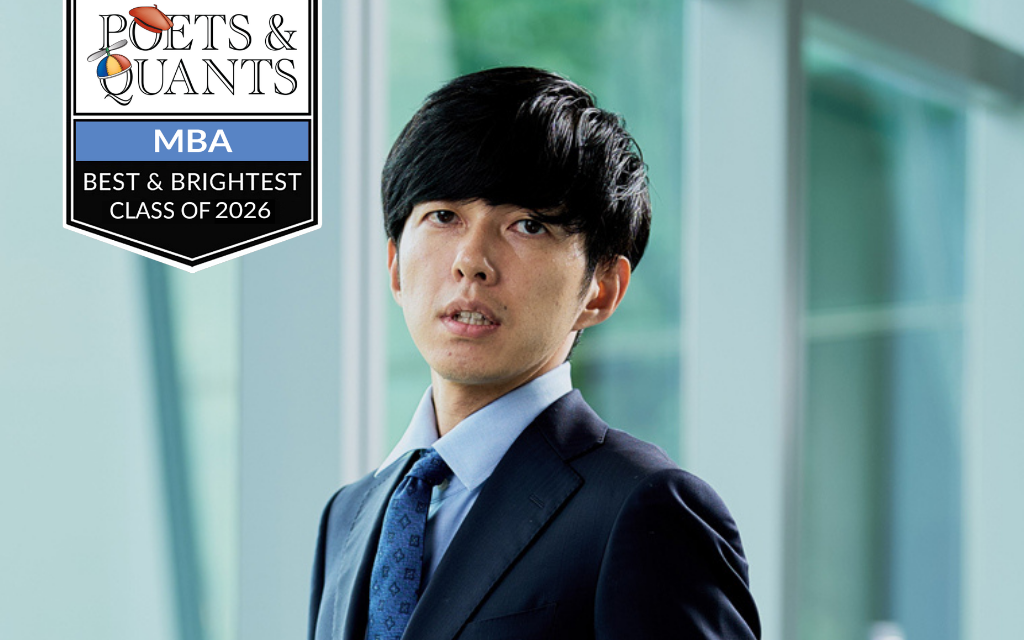
Wataru Komai
“Empathetic leader driving data-driven, long-term decision-making to bridge operational excellence and sustainability in Asia.”
Hometown: Tokyo, Japan
Fun fact about yourself: An ENTJ and Spartan Race finisher who recharges as a “home chef” for my family. To balance a rigorous MBA with raising a son who was only 0 years old when I started, I traveled through Changi Airport over 30 times in 17 months, constantly shuttling between Singapore and my family in Japan.
Undergraduate School and Degree: Keio University (Japan) – Bachelor of Arts in Law (Political Science)
Where was the last place you worked before enrolling in business school? Accenture – Management Consulting Manager, Supply Chain & Operations: Led large-scale digital transformations to shift clients toward data-driven decision-making, streamlining complex global operating models for major manufacturing and pharmaceutical enterprises.
Where did you intern during the summer of 2025? Hydroleap (Singapore) – Strategy & Finance MBA Intern (Office of the CEO/CFO): Extended my impact beyond a summer internship to a year-long engagement at this Singapore-based deep-tech startup. Orchestrated APAC growth strategies, redesigned management KPIs and dashboards, and spearheaded investor relations materials to support fundraising initiatives.
Where will you be working after graduation? Bain & Company – Consultant
Community Work and Leadership Roles in Business School:
President, NUS MBA Sustainability, Ethics and Impact (SEI) Club: Oversaw a community of ESG enthusiasts and led a core team of seven. Revitalized the club by expanding its reach beyond the MBA cohort to include the broader NUS Master’s community and alumni network. Orchestrated a diverse range of activities, including a company visit to a private equity firm specializing in impact investing and multidisciplinary workshops. By integrating business-centric ESG perspectives, I empowered future leaders to bridge the gap between financial returns and societal value.
Student Council (Election Committee): Drove the entire succession process for the next student leadership, ensuring a seamless transition and community vitality. Spearheaded institutional governance reform by formalizing the “By-laws,” which defined core responsibilities and mandatory handover protocols. Furthermore, in response to shifting student demographics, I authored and presented a structural proposal to the MBA Program Office to optimize the club ecosystem.
NUS MBA Admissions Ambassador: Actively supported the admissions team by developing content and speaking at major webinars, engaging with 100+ prospective students. Provided personalized mentorship to 30+ aspirants, directly contributing to the diversity and strength of the incoming class.
Collaborator, NUS BIZAlum Initiatives: Partnered with the Alumni Engagement team to facilitate high-profile guest speaker sessions, strengthening ties between the student body and the global alumni network.
Recipient of the NUS MBA Achiever Scholarship
Which academic or extracurricular achievement are you most proud of during business school? My proudest achievement was bridging academic theory with real-world growth through a year-long internship at Hydroleap, a Singapore-based deep-tech startup. This served as a laboratory to apply NUS MBA insights, specifically from Entrepreneurial Finance, Sustainability Strategy, and B2B Marketing. I worked closely with Professor Markus to refine how these theories could be tailored to a scaling water-tech business.
I spearheaded high-stakes initiatives, including crafting investor-ready white papers and preparing board materials. A highlight was leading the application and pitch deck refinement for a major Southeast Asian startup competition, where we secured 3rd place out of 1,200+ global applicants.
Ultimately, I am most proud of “paying it forward” by designing a new MBA Consulting Project and establishing a recurring internship pipeline, ensuring future cohorts can continue building ecosystems where academia and industry empower one another.
What achievement are you most proud of in your professional career? As the North Asia Regional Procurement Leader at Unilever, I pioneered the integration of post-consumer recycled (PCR) plastic into product packaging, a first for Japan’s FMCG industry. I managed the end-to-end transformation, from securing reliable suppliers to collaborating with R&D and Manufacturing for rigorous quality validation.
This is my proudest achievement because it required navigating the tension between immediate costs and sustainability goals. To secure Board approval, I presented a strategic business case that balanced volume projections with phased cost-reduction roadmaps.
Delivering this industry-first case, announced via a national press release, not only enhanced our brand equity but also catalyzed a shift toward circular economy practices among competitors. This experience taught me the immense value of making decisions through a long-term lens, integrating operational excellence with social value.
Why did you choose this business school? I chose The NUS MBA to master the institutionalization of data-driven decision-making within the unique complexity of the Asian market. During my tenure at Accenture, I witnessed a critical generational shift: while veteran leaders relied on intuition, the next generation faced an urgent need for analytical rigor to navigate a volatile regional landscape. I realized that leading such transformations requires the specialized ability to translate complex data into strategic action. NUS provided the ideal environment, offering a curriculum deeply rooted in Analytics and Operational Excellence at the heart of Asia.
Who was your favorite MBA professor? My favorite professor is Sa-Pyung Sean Shin, an expert in sustainable leadership and ESG-driven management. While his academic rigor is well-known, what truly impressed me was his unwavering support for student-led initiatives. As SEI Club president, I had the privilege of collaborating with him to host a deep-dive workshop for our MBA, EMBA, and alumni communities. Professor Shin delivered an incredible performance, distilling complex topics – from Net-Zero commitments and Scope 1-3 emissions to the intricacies of ESG regulatory shifts – into a high-energy and interactive session.
What I admire most is his ability to balance academic precision with real-world pragmatism, challenging us to navigate the “backlash against ESG” and the tensions between financial viability and environmental responsibility. His dedication to empowering the next generation beyond the standard curriculum has been a cornerstone of my experience.
What was your favorite course as an MBA? The MBA Consulting Project (MCP) was my favorite, where I worked in a team advising a Malaysian ESG SaaS company on its growth strategy. Moving beyond standard coursework, this was an intensely practical experience: we conducted expert interviews and designed a B2B survey that captured deep qualitative insights and data from around 50 SME owners across the region. The highlight was synthesizing these pain points into a demand-driven product roadmap. By resisting the temptation to pursue every AI feature and instead prioritizing functionalities based on adoption potential, we delivered “tough choices” directly to the leadership. Receiving a Distinction for this work solidified my ability to bridge primary market data with the practical realities of scaling a business in the ESG space.
Looking back over your MBA experience, what is the one thing you’d do differently and why? I would have opted for a full-semester exchange rather than a short-term one. I spent my final semester in Singapore because NUS’s elective courses were incredibly attractive, and I wanted to fulfill my internship commitments while securing my career pivot. However, participating in a short-term exchange at Yale SOM was a revelation. It exposed me to a completely different level of diversity and global perspectives that I hadn’t encountered in Asia.
The experience, particularly in Behavioral Science, was so intellectually stimulating that I realized I could have utilized the program’s flexibility to stay longer. Looking back, I could have embraced the full-semester exchange to dive deeper into that unique environment, then returned to Singapore for an extra semester to finalize my professional goals.
What was the most impactful case study you had in business school and what was the biggest lesson you learned from it? The most impactful case study was Komatsu, a leading Japanese industrial machinery manufacturer. It offered a deep dive into how a traditional giant transforms into a data-driven solution provider.
In a high-stakes simulation with our professor acting as CEO, we were challenged to present a comprehensive growth strategy. My team engaged in intense debate over strategic sequencing: Which region would be most receptive to new digital solutions based on local industrial maturity and openness to innovation? We realized that launching from the Japanese headquarters might face the highest internal resistance, so we proposed starting with a pilot in a more agile regional branch to prove the concept before a global rollout.
The biggest lesson I learned was that Corporate Transformation is far more than a growth strategy; it is a multifaceted integration of technology, internal capability building, and organizational politics. This experience showed me that success depends not just on the brilliance of the tech or the strategy, but on how you navigate the operating model and stakeholder interests to make change acceptable across a global organization.
What did you love most about your business school’s town? I loved the duality of Singapore as a high-octane global hub and a close-knit academic sanctuary. Strategically, being in the heart of ASEAN allowed me to witness the region’s dynamism firsthand – whether it was traveling to Indonesia for an internship or taking a short bus ride to Malaysia for a weekend. Equally, I cherished the life at University Town (UTown) within the NUS campus. Living in this vibrant ecosystem with diverse minds from across the globe provided a supportive “home base.” This blend of being at Asia’s business crossroads while having a space for deep reflection and peer connection made my experience unforgettable.
What business leader do you admire most? I admire Mark Carney, former Governor of the Bank of England and current Chair of Brookfield Asset Management. He pioneered the re-engineering of the global financial system to treat climate change as a fundamental financial risk through the TCFD. I am deeply inspired by his cross-industry leadership at COP26, where he transformed sustainability into a concrete financial framework. His work mirrors my own commitment to institutionalizing data-driven, sustainable decision-making, bridging the gap between strategic rigor and long-term societal impact.
What is one way that your business school has integrated AI into your programming? What insights did you gain from using AI? Our school integrated AI into the Analytics for Managers course, where we used Generative AI as a co-pilot for Python-based regression analysis. Our case task was to optimize a RM 10 million budget for Legoland Malaysia by identifying the key drivers of customer satisfaction. We leveraged AI to perform technical data processing, such as detecting outliers using Cook’s Distance and normalizing variables. While AI handled the computations, the quality of our proposal depended on human judgment – interpreting why long-distance travelers showed higher satisfaction and deciding to prioritize operational integrity over aggressive marketing.
The profound insight was that AI democratizes technical execution, but strategic value is determined by the research question. Leadership in an AI-driven world is about being a “master of inquiry,” ensuring that automated outputs are translated into actionable and ethical business outcomes.
Which MBA classmate do you most admire? I most admire Lih Tsern (Laura) Lin. Working closely with her in Analytics for Managers and Structured Problem Solving, I was deeply impressed by her relentless commitment. Her dedication to every task makes her the most reliable and trusted peer I have encountered in the program.
We share a similar habit of over-packing our schedules, but I am constantly amazed by how she manages it all with such grace. Beyond her expertise as a data scientist, she led the Global Immersion Program to Dubai, competed as the only finalist from non-US school in a major healthcare competition, and even took the initiative to organize our social gatherings. Her proactive behavior and genuine desire to contribute to the community are truly inspiring.
Sharing our career aspirations and navigating the uncertainties of our future paths together has been a highlight of my experience. Finding a lifelong friend like Laura, who balances such high professional standards with a warm, community-focused mind, is the greatest treasure of my MBA journey.
What are the top two items on your professional bucket list?
Orchestrate Full-Potential Transformations: I aspire to lead large-scale transformations that redefine how global enterprises operate in the age of AI. My goal is to help C-suite leaders institutionalize data-driven decision-making and agile operating models, ensuring their organizations can navigate generational shifts while maintaining long-term competitiveness.
Drive Cross-Industry ESG Impact: I aim to bridge the gap between short-term profits and long-term sustainability by catalyzing cross-industry initiatives. I want to establish shared practices that integrate ESG into the core of corporate decision-making, transforming sustainability from a compliance task into a fundamental driver of innovation and collective value.
What made Wataru such an invaluable addition to the Class of 2026?
“I’m pleased to nominate Wataru as a standout member of the NUS MBA Class of 2026. During the program, he stood out as a thoughtful and empathetic leader, and served as a role model to his peers through his commitment to sustainability, community engagement, and leading with purpose.
As President of the Sustainability, Ethics and Impact (SEI) Club, he expanded engagement beyond the MBA cohort to the wider NUS and alumni community through initiatives such as impact investing company visits and ESG workshops. He also helped strengthen student governance through his work on the Student Council Election Committee, formalizing by-laws that will benefit future cohorts.
Wataru also embraced experiential learning through his work with Hydroleap, a Singapore-based deep-tech startup focused on water sustainability. Over a year-long engagement, helped shape APAC growth strategies, redesigned management KPIs and dashboards, and develop investor materials for fundraising. This demonstrates his ability to turn classroom insights into real business impact.
His journey was also marked by resilience. During the MBA, he was raising a newborn and travelling between Singapore and Japan more than 30 times in 17 months to support his family. Despite this, he remained active in the NUS MBA community as an admissions ambassador, mentoring prospective students and supporting the programme’s global outreach.
Through his leadership, dedication, and impact, Wataru has left a lasting mark on the NUS MBA Class of 2026. I am confident he will continue to create positive impact in the years ahead.”
Nitin Pangarkar
Academic Director, NUS MBA